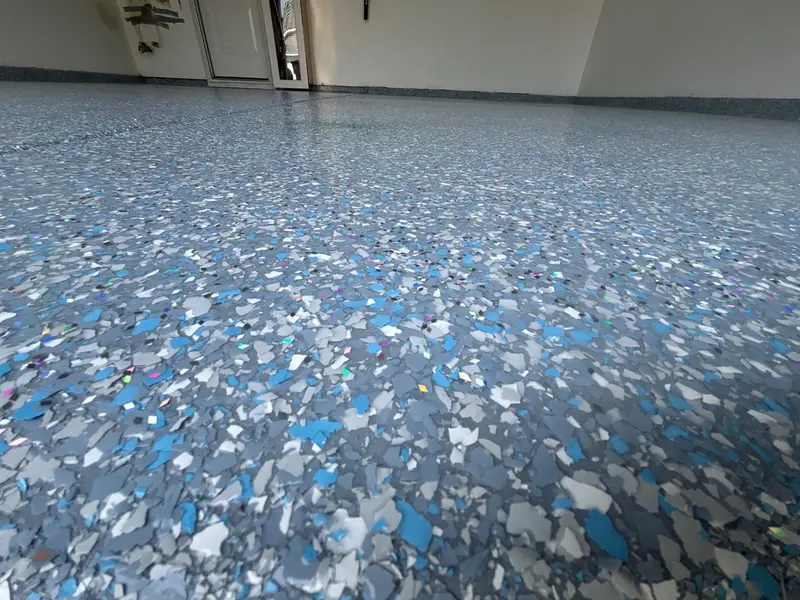
If you get three quotes for a garage floor, at least one will be epoxy and at least one will be polyaspartic, and both will be described as a coating. That is where most homeowners stop reading, because the pitch on both sides is confident and the difference sounds like a brand preference.
It is not a brand preference. They are different chemistries with different failure modes, and the one that matters most in Florida is what sunlight does to them.
The yellowing test, with actual numbers
There is a standard accelerated weathering test, ASTM D4587, that runs coated panels under controlled UV in a cabinet and measures how far the color shifts. The shift is reported as delta E. Anything above 2.0 delta E is considered a change a normal person would notice looking at it.
FLEXMAR, a polyaspartic manufacturer, published a 500 hour run comparing three light gray coatings:
| Coating | Color shift after 500 hours | Noticeable? |
|---|---|---|
| Polyaspartic | 0.89 delta E | No |
| Polyurea | 4.83 delta E | Yes |
| Epoxy | 8.83 delta E | Obviously |
Read the epoxy row again. Roughly ten times the color shift of the polyaspartic, and more than four times the threshold where a person walking into the garage would say something looks off. That is the ambering people describe when they say their white flake floor went cream.
Worth being straight about the source: that study was published by a company that sells polyaspartic. We would tell you to discount a number like that on principle. The reason we are repeating it is that the underlying chemistry is not in dispute. Standard epoxies are aromatic, and aromatic resins break down under UV. Polyaspartics are aliphatic, and aliphatic resins do not. The test result matches what the chemistry predicts, which is the only time a manufacturer's own data is worth much.
Where it actually matters, and where it does not
A sealed garage with no windows and a door that stays shut is close to a dark box. Epoxy in a dark box does not amber, because nothing is hitting it. If that is your garage and nobody in the house cares what the floor looks like in ten years, epoxy is not the disaster the internet says it is.
Florida garages mostly are not that. The door is open half the weekend. There is usually a window or a side entry. Anything outdoors, a lanai, a patio, a driveway apron, a pool deck, gets full sun and is not a close call at all.
Cure time, the other real difference
Polyaspartic cures fast enough that a full grind, base coat, flake broadcast and topcoat can go down in one day, and most systems are walk-on the same evening. Epoxy systems generally need a day between coats, which is why an epoxy job is usually two or three visits.
That speed cuts both ways. Fast cure means short working time, and a crew that is slow on a hot slab will fight it. This is a material that punishes bad installers. If someone is quoting you polyaspartic at a price that seems too good, the question to ask is how many of these they have done, not what the material costs.
What nobody will bring up on their own
Neither chemistry fixes a wet slab. Polyaspartic in particular does not breathe, so vapor pushing up from underneath has nowhere to go and lifts the coating off in sheets. The manufacturers say this in their own literature. It is the single most common reason a coating fails early, and it has nothing to do with which product was used.
That gets its own post, because it is the test almost nobody runs and it decides whether your floor is still there in five years.