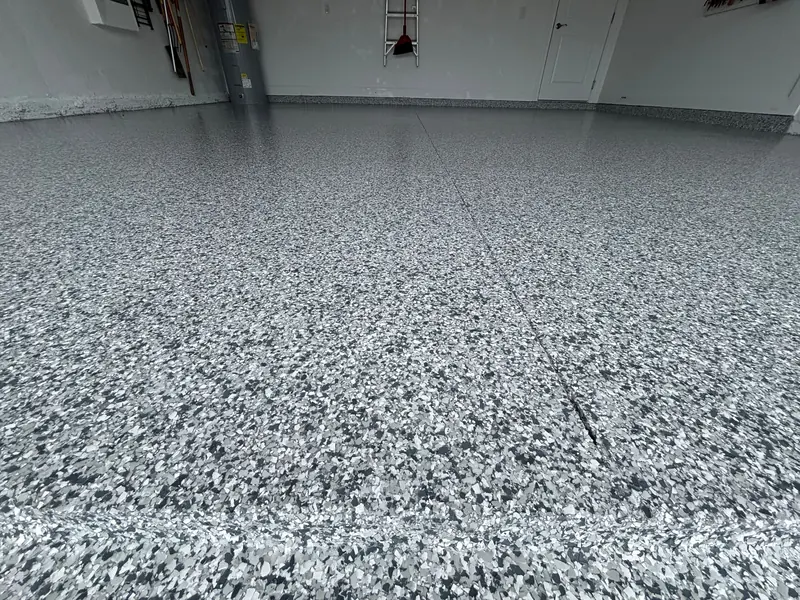
A garage floor coating that peels in sheets a year later almost never failed because the product was cheap. It failed because water vapor was moving up through the slab, had nowhere to go once the surface was sealed, and pushed the coating off from underneath.
Concrete looks dry. A slab poured in 2004 sitting in Brevard County looks as dry as anything you have ever seen. It can still be passing moisture every day, because in Florida the water table is high, a lot of slabs went down with no vapor barrier or a torn one, and concrete moves vapor whether or not the top of it feels damp.
There are two real tests, and they measure different things
Both are ASTM standards. Neither is exotic. A flooring contractor who has never heard of either one is telling you something.
ASTM F1869, the calcium chloride test
A measured dish of calcium chloride is sealed under a dome on cleaned concrete and left for 60 to 72 hours. It absorbs whatever comes out of the slab, and the weight gain gives you a moisture vapor emission rate, reported in pounds per 1,000 square feet per 24 hours.
It measures what is leaving the top of the slab, right now, in the conditions the room is in today.
ASTM F2170, in situ relative humidity probes
Holes are drilled into the slab and sensors are dropped in to read the humidity inside the concrete rather than at its surface. For a slab that can only dry upward, which is most garage slabs on grade, the hole goes to 40 percent of the slab depth. For one that can dry from both sides, 20 percent. The probes need time to equilibrate before the reading means anything, at minimum a day.
It measures what is still in there, which tells you what is going to come out later.
Why the RH test is the one that catches the ugly cases
Calcium chloride reads the surface on the day you test. Run it in January with the garage door open and a dry breeze going through, and the slab surface can read fine while the concrete two inches down is still loaded. Seal that floor in June and the moisture that was sitting deeper has one way out, and it goes through your coating.
The in situ RH test sees that, because it is reading inside the slab instead of off the top of it.
What to do with this
You do not need to become an expert. You need to ask one question and listen to the shape of the answer.
"How are you going to check the slab for moisture before you coat it, and what number are you looking for?"
Three kinds of answer:
- A specific test and a specific threshold. They name F1869 or F2170, and they name the limit their manufacturer sets. This is the answer you want.
- A plastic sheet taped down overnight. This is the old field check. It is better than nothing and it will catch a genuinely wet slab, but it is not a measurement and no manufacturer warranty is written against it.
- "We have never had a problem." That is not a test. It might even be true, and it still does not tell you anything about your slab.
The part that is genuinely inconvenient
Testing costs money and takes days, and on a single residential garage most crews skip it and rely on experience with local slabs. We are not going to pretend that is outrageous, because for a lot of houses it works out fine.
What we will say is this: if a slab tests high, the fix is a moisture mitigation primer under the system, and that is a real line item, not a rounding error. A contractor who tests and then tells you the job costs more is not upselling you. A contractor who never tests and quotes you the low number has moved the risk onto you without mentioning it.
Ask before you sign, not after it lifts.