Three companies quote your garage. The prices are two thousand apart and every one of them sounds certain. Nothing in the paperwork explains the gap, because the paperwork says the same eight words on all three: grind, base coat, flake, topcoat.
The gap is almost always in the prep and the material, and both are invisible once the floor is finished. These nine questions pull them back into view. None require you to know anything technical. What you are listening for is whether the answer is specific.
1. How are you profiling the slab, and with what machine?
You want to hear diamond grinding, and you want them to name the machine. Acid etching and anything described as a chemical prep does not open the concrete enough for a real coating to key into. This is the single biggest hidden difference between a cheap quote and a good one, and it is most of the crew's day.
2. What are you doing about moisture?
Covered in full in the moisture post. Short version: you want a named test and a named threshold, or at minimum a plastic sheet check they will actually do.
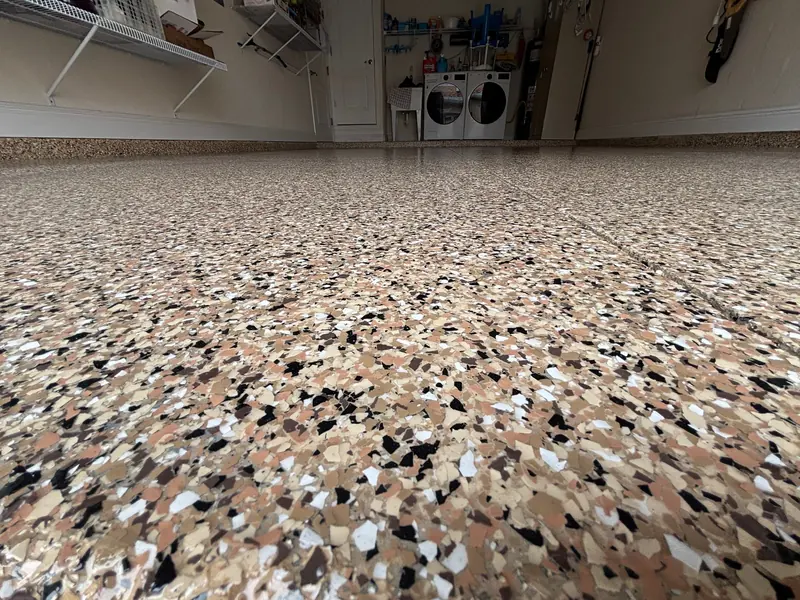
3. Is the flake broadcast to refusal, or to coverage?
Broadcast to refusal means they keep throwing flake until the wet base will not take any more, then scrape and vacuum the excess. Broadcast to coverage means they throw a set amount per square foot. Coverage is cheaper and you can see it: the floor has thin spots where the base color shows through, and it wears unevenly.
4. How many coats, and what is each one?
Ask them to say it out loud in order. A one day flake system is normally a base coat, the flake, and a clear topcoat. If someone quotes a single coat with flake in it, that is a different and much cheaper product.
5. Is the topcoat aliphatic?
This is the one question that sounds technical, and it is worth memorizing because it is a yes or no. Aliphatic means UV stable, which means it does not amber. If the answer is a pause, ask them to send you the product data sheet. The sheet will say.
6. Who is actually doing the work?
The company that sells the job and the crew that shows up are frequently not the same people. That is not automatically bad, it is how most of this industry runs. What is bad is not being told. Ask who is on your driveway, whether they are employees or a sub, and whether they are licensed and insured.
7. What exactly is the warranty on, and who honors it?
There are usually two, and they get blurred together on purpose. The manufacturer warrants the material. The installer warrants the labor. A lifetime warranty on the product means nothing if the company that installed it closes next year, and most coating failures are installation, not material. Get both in writing, with the installer's name on the labor one.
8. What is not included?
Ask it as an open question and let them fill the silence. The usual answers: removing an existing failed coating, structural crack repair, anything vertical like steps or cove base, moisture mitigation. These are legitimate extras. They are only a problem when they turn up after the crew has already ground your floor.
9. When can I park on it?
Walk-on and park-on are different numbers and the second one is longer, usually by a couple of days. If a quote says one day install and does not say when the car goes back in, ask, because a tire sitting on a coating that has not fully cured leaves a mark you cannot buff out.
How to use the answers
Do not score them. Notice which company answered in specifics and which answered in adjectives. Grinding with a named machine, a named test, a named topcoat chemistry and a named installer is a company that has thought about your floor. Premium, industrial grade and lifetime are words anyone can say.
The cheapest quote is sometimes the right one. It is only the right one if it answers these the same way the expensive one did.